


Pathway to mental illness, normality or optimum flow?
Cognitive Principle Matrix has combined the following four theories to explain the different pathways to mental illness, normality and optimum flow from a conceptual point of view.
The four theories are:
1. Neuroscience’s brain network structure comprising of;
- Salience network-fight or flight response which activates the instinctive brain, before the emotional brain is engaged. This provides an instant response to a threat.
- Attentional network-This is he executive functioning network which either switches on the Task Positive Network [TPN] or Default Mode Network [DMN] If the TPN is turned on then there is conscious awareness and resources are allocated to complete the task, others the system defaults to the DMN which is subconscious with no awareness.
What is the Task Positive Network [TPN] and the Default Mode Network [DMN]?
The TPN is responsible for directing our conscious mind towards the external environment through our five senses, towards our internal bodily states and to the wilful execution of physical and mental action.
The DMN is most commonly shown to be active when a person is not focused on the outside world and the brain is at wakeful rest, such as during daydreaming and mind-wandering, but it is also active when the individual is thinking about others, thinking about themselves, remembering the past, and planning for the future. The default mode network is known to be involved in many seemingly different functions:
Information regarding the self:
- Autobiographical information: Memories of collection of events and facts about one’s self
- Self-reference: Referring to traits and descriptions of one’s self
- Emotion of one’s self: Reflecting about one’s own emotional state
Thinking about others:
- Theory of Mind: Thinking about the thoughts of others and what they might or might not know
- Emotions of other: Understanding the emotions of other people and empathizing with their feelings
- Moral reasoning: Determining just and unjust result of an action
- Social evaluations: Good-bad attitude judgments about social concepts
- Social categories: Reflecting on important social characteristics and status of a group
Remembering the past and thinking about the future:
- Remembering the past: Recalling events that happened in the past
- Imagining the future: Envisioning events that might happen in the future
- Episodic memory: Detailed memory related to specific events in time
- Story comprehension: Understanding and remembering a narrative
Andrews-Hanna, Jessica R. (2012-06-01). "The brains default network and its adaptive role in internal mentation".
Professor Marcus Raichle discovered the DMN. His comment was:
“Many of the functions of the network are associated with our perception of our selves. The default mode network is involved in our memory, particularly autobiographic episodic memories. These memories are our personal experiences, associated with a certain time and place, such as what did I have for breakfast today? Where was I yesterday evening? Episodic memory is a special thing. It is very personal and very self-relevant. It integrates memories from our lives in a self-relevant way. This may be the essence of the default mode network”
2. Maslows Hierarchy of Needs
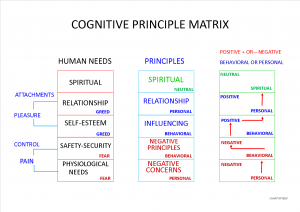
Esteem Needs- DMN Self
Relationship Needs-DMN self and others.
Relationship needs lead to attachment theory. In Cognitive Principle Matrix, relationship principles are trust, respect, acceptance and commitment. If the relationship needs are weakened in early attachment, and continue to be unmet, then Raichle’s DMN explains how these unmet needs are perpetuated by using the DMN in Mind Wandering state. This process of rumination can lead to anxiety, depression and other mental illnesses.
3. Jacob Hohwy's "The Predictive Mind" [2013] which states the following related to how the mind generates perpetual experiences.
“ The brain constructs a model of the world containing hypotheses of all kinds. The mechanism aims at prediction error minimization [PEM]. The brain predicts the sensory inputs with the inputs it actually receives. If there is a match between the predicted and actual inputs, the model is confirmed. If there is a mismatch, prediction error occurs and the brain revises the model, generates new predictions and tests them against subsequent events.”
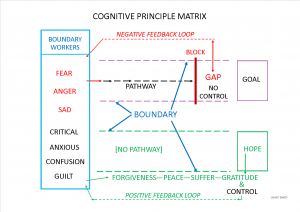
Combing Raichle’s DMN theory and Hohwy’s PEM then the Cognitive Principle Matrix looks like this:
In TPN using conscious negative thinking or in DMN using negative Mind Wandering creates mental illness, if the loop continues for long periods of time.
Negative Trigger- Negative predictive-comparative loop [rumination]
In TPN using conscious positive thinking creates normality. When there is a clear goal, high motivation and high awareness, then flow is created
Positive Trigger- Positive predictive-comparative loop. [conscious]
In TPN using Creative Mode creates optimum flow. For this to occur there is pure awareness, no conscious thought either negative or positive and there is hope, that is, knowing you have already achieved the goal before you start.
Positive Trigger- Positive predictive-comparative loop. [subconscious]
4. Cognitive Principle Matrix's three levels of control.
By combing CPM's three levels of control with the other theories, then the outcome as as follows:
(i) Involuntary control by the subconscious mind, mainly resulting in bad habits.
TPM-Subconscious thinking, while performing a DMN procedural [negative habit]
DMN-Procedural [negative habit]
DMN-Mind wandering [negative] (ii) Voluntary control using the conscious logical mind.
TPM-Conscious thinking
TPM-Subconscious thinking, while performing a DMN procedure [positive habit] (iii) Voluntary giving up control to the subconscious mind to achieve optimum flow. .
DMN-Creative thinking
DMN-Mind wandering [positive]
The conscious mind is aware of the mind wandering and has control over it.
The pathways to mental illness and optimum flow are more aligned than the pathway to normality.
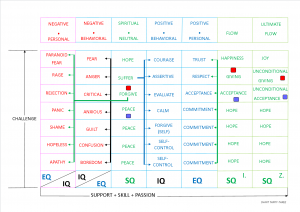
- Pathway to Mental Illness
Most issues presented in counselling relate to weakened groups of principles, caused by past experiences. The weakened principles are caused by rumination.
Negative Trigger- Negative predictive-comparative loop [rumination]
While operating using involuntary control by the subconscious mind in any of the following three states.
- TPM-Subconscious thinking, while performing a DMN procedural [negative habit]
- DMN-Procedural [negative habit]
- DMN-Mind wandering [negative]
- Affect on principles when engaging on the above three states:
- Relationship principles: with others or self:
Lack of trust, respect, acceptance or commitment.
- Influencing principles [esteem]: with self and others:
Lack our courage, assertiveness, evaluation or self-control
- Negative principles: with self
Feelings of excess fear, anger, criticalness, anxiousness, guilt or confusion.
- Problems in dealing with negative concerns and or escaping from them using false positive emotions:
Feelings of paranoid fear, rage, rejection, panic, shame or hopelessness.
Avoidance [addictions], fantasy, greed & self-centeredness
B. Pathway to flow:
Voluntary control using the conscious logical mind.
TPM-Conscious thinking
The steps typically involve goal setting, plans and pathways, using the logical mind. The limitation of this pathway is the slow speed of the conscious mind, that is, one million times slower than the subconscious mind.
C. Pathway to optimum flow:
Voluntary giving up control to the subconscious mind to achieve optimum flow. The speed of processing is one million times faster than conscious processing.
DMN-Creative thinking
DMN-Mind wandering [positive]
The cognitive principle matrix uses an inside-outside process to achieve optimum flow which includes the following:
- Unconditional acceptance [no fear]
- Unconditional giving [no greed]
- Operating in the present [no distraction of past or future.]
- Pure awareness, no conscious thinking, either positive or negative
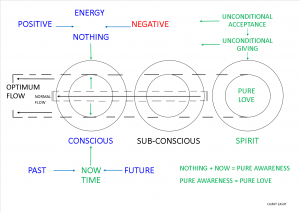
- Hope [knowing the outcome, even though the pathway to the outcome is unkown] rather than goals.
- Predictive thinking, but no comparative thinking
- Using spiritual principles, which are neutral. These are built into the subconscious mind as core values.
The author, Robert McInnes is a flow coach, specialising in optimum flow. This field is new and most of the research is built around using the DMN in Creative Mode. That is, external performance is achieved without conscious thought, using the speed of the subconscious mind and the power of the predictive mind. In this mode there are no external goals because the outcome is known [hope] before the process starts, however, the pathway to achieve the outcome is not known. The predictive mind produces the pathway subconsciously.
If an AI robot gets this process wrong and a negative factor enters the Predictive-Comparative-Loop and this process cannot be stopped, then the equivalent of mental illness will occur.
This article is a continuation of the concept of mindful singularity versus technological singularity:


