


What if we developed “Mindful Singularity” to combat “Technological Singularity”
What is Technological Singularity?-Ray Kurzweil’s view. [refer wikipedia]
The Singularity Is Near: When Humans Transcend Biology is a 2006 non-fiction book about artificial intelligence and the future of humanity by inventor and futurist Ray Kurzweil.
Kurzweil describes his law of accelerating returns which predicts an exponential increase in technologies like computers, genetics, nanotechnology, robotics and artificial intelligence. He says this will lead to a technological singularity in the year 2045, a point where progress is so rapid it outstrips humans' ability to comprehend it.
Kurzweil predicts the technological advances will irreversibly transform people as they augment their minds and bodies with genetic alterations, nanotechnology, and artificial intelligence. Once the Singularity has been reached, Kurzweil says that machine intelligence will be infinitely more powerful than all human intelligence combined. Afterwards he predicts intelligence will radiate outward from the planet until it saturates the universe.
Some People Who Think Artificial Intelligence Could Bring the Apocalypse
Stephen Hawking
“The development of full artificial intelligence could spell the end of the human race,” the world-renowned physicist told the BBC. “It would take off on its own and re-design itself at an ever increasing rate. Humans, who are limited by slow biological evolution, couldn’t compete, and would be superseded.”
Elon Musk
Known for his businesses on the cutting edge of tech, such as Tesla and SpaceX, Musk is no fan of AI. At a conference at MIT in October, Musk likened improving artificial intelligence to “summoning the demon” and called it the human race’s biggest existential threat. He’s also tweeted that AI could be more dangerous than nuclear weapons.
Nick Bostrom
The Swedish philosopher is the director of the Future of Humanity Institute at the University of Oxford, where he’s spent a lot of time thinking about the potential outcomes of the singularity. In his new book Superintelligence, Bostrom argues that once machines surpass human intellect, they could mobilize and decide to eradicate humans extremely quickly using any number of strategies (deploying unseen pathogens, recruiting humans to their side or simple brute force).
What is Mindful Singularity?
Mindful singularity occurs when:
- The conscious mind works with the subconscious mind to construct a “patterning system”, which when designed to a certain stage, will then “progressively redesign itself” without the input of the awareness of the conscious mind.
- Receiving an activating event, the patterning system will automatically solve the problem without conscious awareness.
- The system operates in a state of optimum flow using the brain’s Default Mode Network in creative phase. Currently research has shown that the average person operates in the mind wandering phase of the default mode network for 42% of the time. The challenge is to convert the mind wandering phase into the creative phase using mindful singularity.
- The system uses internal goals, called “hope” and does not rely on external goals. Hope is “knowing” the end result will be achieved, but not knowing how that will happen or the pathway to make it happen.
- The two drivers of human nature, namely, fear and greed, are over ridden by unconditional acceptance [fear] and unconditional giving [greed], therefore the system is not interrupted by human emotional needs. The minds predictive system is in operation and not the comparative system.
- The conscious mind is fully aligned with the subconscious mind and accepts what the subconscious mind creates. However, the subconscious mind is governed by a set of rules, boundaries and consequences which are learned and built into the subconscious mind by the conscious mind.
- That people work in their own creative fields, then come together through subconscious connection to create an integrated whole, which is global mindful singularity. For this to occur the model has to be built around a common set of rules, boundaries and consequences, based on relationship needs [attachment needs], which are trust, respect, acceptance and commitment.
In this conceptual theoretical model, mindful singularity will be greater than technological singularity and the result may be to stop technological singularity from progressing. Technological singularity is forecast to occur in 2045. The goal is to create Mindful singularity before that date.
How is the Cognitive Principle Matrix attempting to create mindful singularity.
The Cognitive Principle Matrix is built on the conceptual theory of opposites or complimentary pairs. It started on 26th May, 2003, from Stephen Covey’s book “The 7 Habits of Highly Successful People” where he talked about the “personality ethic versus the character ethic”. It was then constructed around Maslow’s “Hierarchy of Needs” by attaching principles, which are composed of values and emotions, to Maslow’s needs. Below [right hand side] is a simple model of how to rise up from the lowest level in the hierarchy of needs to the top level.
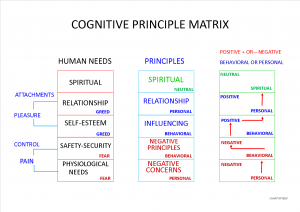
The initial hierarchical model show above was later revised as a inside/outside model. It uses the subconscious mind's predictive system, rather that the comparative system for decision making.
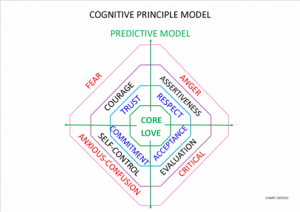
There are seven sets of guiding rules which provide the boundary for the simple model, which are based on the following pairs:
- Conscious versus Subconscious
- Principle thinking versus Negative comparative thinking
- Inside versus Outside
- Support versus Challenge
- Influence versus Concern
- Control versus Responsibility
- Behavior versus Person
Each of the above sets of guiding pairs has a theory attached to it. Once the simple model is triggered the learned theory is activated in the subconscious mind through the use of the conceptual model. For example, the Support versus Challenge theory can be expressed in chart form, to take a person from apathy and hopelessness to optimum joy, as shown below:
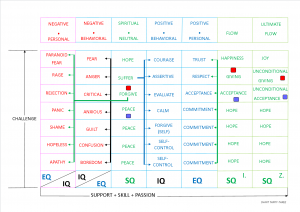
Another example of the model, notating the abridged theory, is shown below.
- The negative principle of “anger” is activity by a trigger. The theory related to negatives principles is that they are behavioral and not personal, therefore a process response arises, not an emotional response.
- All negative principles are controlled by the spiritual principle of “suffering” which is based on Victor Frankl’s theory in “Man Search for Meaning.” You can suffer and grow or suffer and blame. In the CPM model you automatically suffer and grow an “influencing principle”. The influencing principle related to anger is assertiveness.
- Influencing principles are behavioral, not personal. The theory behind influencing principles is to grow them every day. They grow faster in negative situations, than in positive situations. For example, you don’t grow courage if you are never tested with fear. You don’t grow self control if you get everything you want.
- The theory is the more you grow your influencing principles, then the greater is the growth in your relationship principles. For example, the more courage you have, the greater is your trust. The more self-control you have, then the more you commit.
- Relationship principles are based on attachment theory. That is, you need to attach as a baby and continue to attach throughout your life. You attach through trust, respect, acceptance and commitment.
- The theory is to build rules, boundaries and consequences around relationship principles. For example, my “respect” rule about verbal abuse is, when I say stop, you stop. If you don’t stop, then I am walking away and the consequence for you is “ …..………”
All of the above steps are built into the subconscious mind as a habit, using the Cognitive Principle Matrix framework.
Example: My partner verbally abuses me, I automatically become angry, then assertive and tell my partner to stop. They don’t, so I walk away and after they have calmed down, I give them the consequence. This happens automatically with no emotion. Using this process, I build my assertiveness, I grow respect for myself, and I honor my identity through following my rules, boundaries and consequences.
Note: If my partner is genuinely remorseful and apologies, then I automatically active the spiritual principle of forgiveness, which is based on splitting the person from their behavior. I put the behavior aside, and I forgive the person. This builds the relationship principle of acceptance and I grow in the process. Relationship principles are emotional, not behavioral, so I may tell my partner that I love them an display this with emotion.
The future of psychology and counselling
Based on the latest development of neuroscience and the understanding of the components of the brain it appears that deep brain stimulus, which release chemicals, such as dopamine, serotonin and oxytocin, will take over from a pharmaceutical approach, producing a quicker more effective response with less side affects, for treating OCD, depression, anxiety and other mental illnesses. However, while electrical or chemical solutions may overcome mental illness faster than conventional therapy such as CBT, the client has no awareness or understanding how they overcame the problem, therefore, there is no personal growth.
In the future the role of the psychologist is to diagnose the condition, and the role of the counsellor is to provide the psycho education related to the change that is taking place. However, a psychological model like the cognitive principle matrix can be used by both psychologists and counselors as a preventive psycho-educational, so that bad habits resulting form defense mechanism can be eliminated before they become mental illnesses.
Example using the Cognitive Principle Matrix.
The Cognitive Principle Therapy [CPT] is 70% psycho-educational and 30% combination of person centered and CBT. For example it uses a particular technique called the Stop, Find Method [TM] to overcome anger. This method is similar to hypnosis, but does not use hypnosis or self-hypnosis. The method creates a very low level of conscious awareness, then a mantra is repeated which creates a subconscious connection between anger and calmness. After saying the mantra for two days, then when anger is triggered, both anger and calmness are automatically retrieved from the subconscious mind without conscious thought. Anger is reduced by 50% within a week using this technique.
The technique described above is linking a negative principle of anger to an influencing principle of calmness in the subconscious mind. It is activated by an anger trigger, without conscious thought. In CPT, the counsellor uses psycho-education to explain to the client how to create the technique and how the conscious and subconscious mind works to process it.


