


Reducing stress using the cognitive principle matrix.
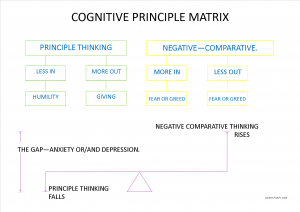
The Cognitive Principle Matrix (CPM) is a matrix developed to change negative behavior patterns. For simplicity negative behavior patterns are referred to as bad habits.
The bad habits and located and controlled by the sub-conscious mind, not the conscious mind. The thoughts and feelings related to the sub-conscious mind are not acceptable to the conscious mind and this state is said to be non-aligned.
The purpose of CPM is to align the conscious and sub-conscious mind using a four stage process.
Stage 1: Understanding how the conscious and sub-conscious mind work together.
Stage 2. To understand that as negative comparative thinking rises, then principles fall, creating a bad habit or defense mechanism. The purpose of CPM is to reverse this process by creating a new habit. The main tool to do this is the “stop, find, method”
Stage 3 Attach the new habit to the bad habit using the “stop, find, method” and experience the reduction in the bad habit.
Stage 4. Develop understanding and awareness of the seven elements of a bad habit and the five levels of principle groups, which provide the basis for maintaining the good habit.
Principle Thinking versus Negative Comparative Thinking.
At the basic level we have needs and wants. This is built into our human nature and drives our comparative thinking. When we achieve our wants and needs, we want more. However, if we consistently fail to get our needs and wants met then we develop negative comparative thinking.
To control our human nature we have a conscience which controls how we get our needs and wants met. Out of our conscience grows our principles of trust, respect, honesty etc. Therefore, at the basic level of human behavior there are two opposing forces at work in negative situations, namely, comparative thinking and principle thinking.
In cognitive principle theory the two highest principles are humility and giving, which are the direct opposites of comparative thinking related to achieving goals. Goals are based on a comparison between “where I am” and “where I want to be”. Goals are driven by fear of a bad goal and greed for a good goal. Humility is unconditional acceptance of strengths and weaknesses and there is no goal. Unconditional giving is where you give without wanting anything back and there is no goal. You use unconditional acceptance and unconditional giving when you are overwhelmed with stress. CPM teaches the process of how to get to this level, by rising through the five levels of the matrix.
The CPM rule is that when negative comparative thinking rises, then principles fall. For example, if a person thinks in a jealous way about a situation, then the principle of trust falls.
The American Psychological Association has defined emotional stress as a combination of anger, anxiety and depression. Stress is a major cause of mental and physical health issues. The cognitive principle matrix was originally created in 2003 to reduce stress based on the principle that when negative comparative thinking rises then principles fall and the stress gap widens [see chart above].
Cognitive principle therapy reduces negative comparative thinking while increasing principles at the same time. No other therapy attempts to do this as its main strategy.
The American Psychological Association traditional approach has been to define the three types of emotional stress and treat them using different techniques. The APA states:
“Stress management can be complicated and confusing because there are different types of stress — acute stress, episodic acute stress, and chronic stress — each with its own characteristics, symptoms, duration and treatment approaches. Let's look at each one.
Acute stress
Acute stress is the most common form of stress. It comes from demands and pressures of the recent past and anticipated demands and pressures of the near future. Acute stress is thrilling and exciting in small doses, but too much is exhausting. A fast run down a challenging ski slope, for example, is exhilarating early in the day. That same ski run late in the day is taxing and wearing. Skiing beyond your limits can lead to falls and broken bones. By the same token, overdoing on short-term stress can lead to psychological distress, tension headaches, upset stomach and other symptoms.
Fortunately, acute stress symptoms are recognized by most people. It's a laundry list of what has gone awry in their lives: the auto accident that crumpled the car fender, the loss of an important contract, a deadline they're rushing to meet, their child's occasional problems at school and so on.
Because it is short term, acute stress doesn't have enough time to do the extensive damage associated with long-term stress. The most common symptoms are:
• Emotional distress — some combination of anger or irritability, anxiety and depression, the three stress emotions.
• Muscular problems including tension headache, back pain, jaw pain and the muscular tensions that lead to pulled muscles and tendon and ligament problems.
• Stomach, gut and bowel problems such as heartburn, acid stomach, flatulence, diarrhea, constipation and irritable bowel syndrome.
• Transient overarousal leads to elevation in blood pressure, rapid heartbeat, sweaty palms, heart palpitations, dizziness, migraine headaches, cold hands or feet, shortness of breath and chest pain.
Acute stress can crop up in anyone's life, and it is highly treatable and manageable.
Episodic acute stress
There are those, however, who suffer acute stress frequently, whose lives are so disordered that they are studies in chaos and crisis. They're always in a rush, but always late. If something can go wrong, it does. They take on too much, have too many irons in the fire, and can't organize the slew of self-inflicted demands and pressures clamoring for their attention. They seem perpetually in the clutches of acute stress.
It is common for people with acute stress reactions to be over aroused, short-tempered, irritable, anxious and tense. Often, they describe themselves as having "a lot of nervous energy." Always in a hurry, they tend to be abrupt, and sometimes their irritability comes across as hostility. Interpersonal relationships deteriorate rapidly when others respond with real hostility. The workplace becomes a very stressful place for them.
The cardiac prone, "Type A" personality described by cardiologists, Meter Friedman and Ray Rosenman, is similar to an extreme case of episodic acute stress. Type A's have an "excessive competitive drive, aggressiveness, impatience, and a harrying sense of time urgency." In addition there is a "free-floating, but well-rationalized form of hostility, and almost always a deep-seated insecurity." Such personality characteristics would seem to create frequent episodes of acute stress for the Type A individual. Friedman and Rosenman found Type A's to be much more likely to develop coronary heat disease than Type B's, who show an opposite pattern of behavior.
Another form of episodic acute stress comes from ceaseless worry. "Worry warts" see disaster around every corner and pessimistically forecast catastrophe in every situation. The world is a dangerous, unrewarding, punitive place where something awful is always about to happen. These "awfulizers" also tend to be over aroused and tense, but are more anxious and depressed than angry and hostile.
The symptoms of episodic acute stress are the symptoms of extended over arousal: persistent tension headaches, migraines, hypertension, chest pain and heart disease. Treating episodic acute stress requires intervention on a number of levels, generally requiring professional help, which may take many months.
Often, lifestyle and personality issues are so ingrained and habitual with these individuals that they see nothing wrong with the way they conduct their lives. They blame their woes on other people and external events. Frequently, they see their lifestyle, their patterns of interacting with others, and their ways of perceiving the world as part and parcel of who and what they are.
Sufferers can be fiercely resistant to change. Only the promise of relief from pain and discomfort of their symptoms can keep them in treatment and on track in their recovery program.
Chronic stress
While acute stress can be thrilling and exciting, chronic stress is not. This is the grinding stress that wears people away day after day, year after year. Chronic stress destroys bodies, minds and lives. It wreaks havoc through long-term attrition. It's the stress of poverty, of dysfunctional families, of being trapped in an unhappy marriage or in a despised job or career. It's the stress that the never-ending "troubles" have brought to the people of Northern Ireland, the tensions of the Middle East have brought to the Arab and Jew, and the endless ethnic rivalries that have been brought to the people of Eastern Europe and the former Soviet Union.
Chronic stress comes when a person never sees a way out of a miserable situation. It's the stress of unrelenting demands and pressures for seemingly interminable periods of time. With no hope, the individual gives up searching for solutions.
Some chronic stresses stem from traumatic, early childhood experiences that become internalized and remain forever painful and present. Some experiences profoundly affect personality. A view of the world, or a belief system, is created that causes unending stress for the individual (e.g., the world is a threatening place, people will find out you are a pretender, you must be perfect at all times). When personality or deep-seated convictions and beliefs must be reformulated, recovery requires active self-examination, often with professional help.
The worst aspect of chronic stress is that people get used to it. They forget it's there. People are immediately aware of acute stress because it is new; they ignore chronic stress because it is old, familiar, and sometimes, almost comfortable.
Chronic stress kills through suicide, violence, heart attack, stroke and, perhaps, even cancer. People wear down to a final, fatal breakdown. Because physical and mental resources are depleted through long-term attrition, the symptoms of chronic stress are difficult to treat and may require extended medical as well as behavioral treatment and stress management.
Adapted from The Stress Solution by Lyle H. Miller, PhD, and Alma Dell Smith, PhD.”
Cognitive principle therapy uses the same techniques irrespective of the type of stress.
The most important factor is how each person individually deals with the stress, not the type or the severity of the stress.
Cognitive principle therapy uses the term “bad habits” which are defense mechanisms. It is important in therapy to identify the defense mechanism and change it by reducing the negativity on which it is built and strengthen the weakened principle which it causes.
Defense mechanisms are broken into four groups as shown below. Each group comprises two negative defense mechanisms and one false positive. The false positive occurs when the person can’t face the negative defense mechanism and flips to the opposite.
This subconscious process provides the understanding for the cognitive principle therapist to create a new habit based on a true positive, not a false one. False positives are the most difficult to shift because most client's believe they are true.
Denial group:
1. Denial. Denial is the refusal to accept reality or fact, acting as if a painful event, thought or feeling did not exist. .
2. Dissociation. Dissociation is when a person loses track of time and/or person, and instead finds another representation of their self in order to continue in the moment.
3. Reaction Formation. Reaction Formation is the converting of unwanted or dangerous thoughts, feelings or impulses into their opposites.
Regression group:
4. Regression. Regression is the reversion to an earlier stage of development in the face of unacceptable thoughts or impulses.
5. Repression. Repression is the unconscious blocking of unacceptable thoughts, feelings and impulses. The key to repression is that people do it unconsciously, so they often have very little control over it.
6. Sublimation. Sublimation is simply the channeling of unacceptable impulses, thoughts and emotions into more acceptable ones.
Displacement group:
7. Displacement. Displacement is the redirecting of thoughts feelings and impulses directed at one person or object, but taken out upon another person or object.
8. Projection. Projection is the misattribution of a person’s undesired thoughts, feelings or impulses onto another person who does not have those thoughts, feelings or impulses.
9.Undoing. Undoing is the attempt to take back an unconscious behavior or thought that is unacceptable or hurtful
Intellectualizing group:
10. Intellectualization. Intellectualization is the overemphasis on thinking when confronted with an unacceptable impulse, situation or behavior without employing any emotions whatsoever to help mediate and place the thoughts into an emotional, human context.
11. Compartmentalization . Compartmentalization is a lesser form of dissociation, wherein parts of oneself are separated from awareness of other parts and behaving as if one had separate sets of values.
12. Compensation. Compensation is a process of psychologically counterbalancing perceived weaknesses by emphasizing strength in other areas.
The client is made aware of the particular defense mechanisms they are using and are then cognitively challenged on the negative beliefs on which they are based. They are then given a mantra using the "Stop, find method" to create and new habit. They are also trained in the seven elements of a bad habit and how to progress through the five levels of the cognitive principle matrix. Approximately 70% of the therapy is psycho-educational.


