We need both mindfulness and emotionfulness.
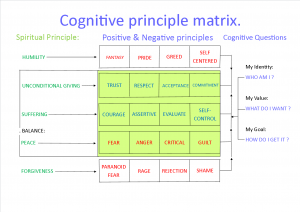
The long term goal of the Cognitive Principle Matrix [CPM] is to use both mindfulness and emotionfulness to control the subconscious mind’s process over time and emotions. In its normal state the subconscious mind bases future predictions on past events and emotions. There are no predictions made from the present state
Mindfulness is the practice of bringing one's attention to the internal and external experiences occurring in the present moment, which can be developed through the practice of meditation.
Emotionfulness is the practice of bringing one’s emotions into the present moment based on the future goal and the appropriateness to the present experience and not based on past experiences.
The 2 D version of the CPM
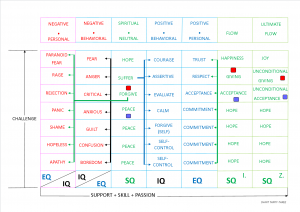
The CPM presented up to 2015 was the 2 D version, the plan over the next 10 years is to develop it into a 3 D version, where all the elements are linked. The 30 year plan is develop it into a 4 D version where, when faced with an IQ, EQ or SQ trigger you automatically know where you are in the matrix [subconscious mind] and can follow the pathway to solve the problem or create the opportunity, without thinking about it consciously. This process is following the development of AI and involves exponential growth and optimum flow. The knowledge from the past is very relevant to achieve this goal, but the techniques used in the past become irrelevant, very quickly.
The goal is to:
- Pursue exponential growth related to psychological development. There are three types of growth, namely;
- Linear Growth -No flow, with psychological development based on the natural process of the subconscious brain. That is, the future [my immediate decision] is based on a prediction of the past and the current issue, related to the past outcomes.
- Cumulative growth-Flow, with psychological development based on the conscious mind having clear goals, with motivation to achieve those goals and self-control to override the past emotions, if they are not relevant to the current issue. The predictive mind uses both the future goal and the past outcomes to arrive at a decision.
- Exponential growth-Optimum flow, with psychological development based on the predictive mind knowing that the future goal will be achieved and allocates resources in the present towards achieving that goal. Emotions are allocated based on the future goal and the current issue and not on past experiences. All decisions are made subconsciously.
The reason for using exponential growth over cumulative growth is because the subconscious mind’s processing speed is one million times faster than the conscious mind. The metaphor for goal achievement using the different methods is to seen in mathematics:
Measure: one step equals one meter:
No Flow Flow Optimum Flow
Linear Growth Cumulative growth Exponential Growth
Meters Meters Meters
After 1 step 1 1 1
After 5 steps 5 15 16
After 30 steps 30 465 1,000,000,000
(26 times around world)
- How to use the minds network to create optimum flow? The answer is to direct the mind’s Attentional network to the Default Mode Network-creative mode.
About The brain’s network: Neuroscience has revealed that our brain network structure is comprised of;
- Salience network-fight or flight response which activates the instinctive brain, before the emotional brain is engaged. This provides an instant response to a threat.
- Attentional network-This is he executive functioning network which either switches on the Task Positive Network [TPN] or Default Mode Network [DMN] If the TPN is turned on then there is conscious awareness and resources are allocated to complete the task, otherwise the system defaults to the DMN which is subconscious with no awareness.
In CPM there are eight states of mind operating under three levels of control.
(i) Involuntary control by the subconscious mind, mainly resulting in bad habits.[No flow] This is where most clients with mental illness enter counselling.
- DMN-Mind wandering [negative]
- TPN-Conscious thinking [negative], while performing a DMN procedural [negative habit] The negative habit is the driver of the negative thinking.
(ii) Voluntary control using the conscious logical mind.[potential for Flow]
- TPN-Conscious thinking [positive]
- TPN-Conscious Thinking [negative]
- TPN-Conscious thinking [ positive], while performing a DMN procedure [positive habit] The positive thinking is the driver of the positive habit.
(iii) Voluntary giving up control to the subconscious mind to achieve optimum flow. .
- DMN-Creative thinking
- DMN-Mind wandering [positive]
The conscious mind is aware of the mind wandering and has control over it.
How to convert the Wandering mind to the creative mind.
Matt Killingsworth’s “Does a Wandering Mind, make you Unhappy” a study of 15,000 people across 83 professions found that our mind wanders 46% of the time and we are unhappy when it does wander. Most wandering involves rumination, that is, creating negative predictive-comparative loops.
This study showed that 46% of the time our mind is wandering, not working effectively towards our goal and therefore missing a great opportunity for growth. We have now learned how mindfulness brings our wandering mind back to the present through using the TPN to focus on an external or internal object. We now have to learn how to disconnect our emotions from the past and apply them to the present.
In CPM we use spiritual principles, and Maslow’s hierarchical structure of needs to learn how to control emotions. At present this is done consciously. In the future we will construct a model of neural pathways based on the Cognitive Principle Matrix. We will learn how to create models of pathways quickly, just like how we now create procedural task habits through repetition. By converting the 46% of time spent in DMN mind wandering mode to time spent in the DMN creative mode, then will grow exponentionally once the neural pathway model is operational.