


How to succeed in a team sport using Cognitive Principle Matrix’s rules of attachment-detachment.
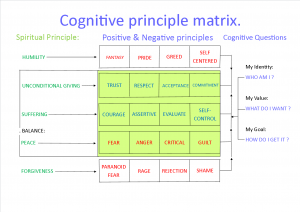
The team will have a goal:
All teams have goals built around the following four questions:
- Who are we
- What do we want
- Why do we want it.
- How to we get it. This includes the rules, boundaries and consequences which provide the control to achieve the first three.
The player will have a goal:
- Who am I
- What do I want
- Why do I want it.
- How to I get it. I will commit to the rules, boundaries and consequences which provide the control to achieve the first three.
The most successful player will have the highest level of attachment to the team goal, because they will optimize both their own performance and the team’s performance, which is the goal of team sports.
The Five steps to achieve success:
Playing sport involves following 5 steps of attachment-detachment, using the cognitive principle matrix.
- Skill Preparation [detachment- it is a process], that is, gain knowledge, skill, experience through practice. All learning is done through repetition. If two players start with the same skill, then the person with the most repetitions is the best. There is no short cut in step 1.
- Game preparation [attachment- it is a relationship]. Give unconditional support to every team member, so they know that you are there for them.
- Game commences [detachment]. It’s not personal, it’s a process. Do not think, do not show emotion, just execute, so as to repeat the highest level achieved in practice.If you make a mistake, detach from emotion, use suffering and grow more courage, patience, persistence and self-control.
- Score achieved [attachment] That is, praise the person who achieved success, but remind them to detach and focus. If you scored then accept the praise, use humility, and return to focus. [detachment]
- Game concludes [attachment] Thank the opposition and share the glory or disappointment with your teammates.
The Cognitive Principle Matrix is based on 7 rules.

The following rules apply to playing a team game.
Rule 1 Conscious thinking versus subconscious thinking.
Rule 2. Principle Thinking versus Comparative Thinking
Apply this rule to:
Detachment from conscious thinking, when involved in actual play.
Attachment to conscious thinking, when not involved in play.
This rule is counter intuitive for playing in a game. However, these are the facts:
- The conscious mind [neocortex] is very smart, but very slow, where as the subconscious mind [gut] is dumber, but very quick [one million times faster]. A game is played using the subconscious procedural memory, which is a habit. To successfully execute a habit, just do it, do not think.
- When you are not in the game, attach to the conscious mind. If you are not in the conscious mind, but are waiting for play, then the subconscious mind will move to what is called “default mode-mind wandering” phase which is normally negative thinking. Matt Killingsworth’s “Does a Wandering Mind, make you Unhappy” a survey of 15,000 people, across 83 occupations reported that people are in “mind wandering” phase 46% of the time, whether at home or at work. This can be seen in team games, when they move in and out of “the zone” It is the teams that can stay out of the mind wandering phase, and consciously focus, will win the match. You must not think about the game, making comparisons while you are waiting. Focus your attention to procedural “drills” while you are waiting or think about positive non game thoughts or read the play that is happening in front of you, but do not make comparisons.
Rule 2. Principle Thinking versus Comparative Thinking
Rule 3. Inside versus Outside
Apply these rules to:
Detachment from the goal
Attachment to hope. [spiritual principle]
- You should never go into a game with a goal of winning or trying to score, because that creates “comparative thinking” and emotions which is hard to detach from. This also applies to actions when the game commences.
- You go into a game using the highest level principles which are “spiritual”. That is, start with “hope” which is ‘knowing that you have achieved the goal before you start.” It is the ultimate confidence. Once something is known, then there is no fear, because there is no comparison to be made. However, hope is built into you “gut” brain, you do not think about it, just do it. It applies to every individual transaction that arises during a game, but only attempt one transaction at a time.
- When in the game, detach from outside influences, just focus on the next transaction, knowing that you can execute it.
Rule 2. Principle Thinking versus Comparative Thinking
Rule 4 Influence versus concern
Apply this rule to:
Detachment from the past
Detachment from the future
Attachment to the present.
- In a game the past is of concern, which means you can do nothing about it, only make a comparison and broken rule 2.
- In a game the future is for planning or “worrying” that the plan is not working. You are not the coach, you cannot be a planner and a player. Stop making comparisons.
- Attachment to the present. Focus on the present which the next second that confronts you.
Rule 2. Principle Thinking versus Comparative Thinking
Rule 5 Support versus challenge.
Apply this rule to:
Detachment from comparative thinking
Attachment to principle thinking
- If there is balance between support versus challenge in a game, then motivation will not be an issue, because competition is high. If however, there is no challenge from the opposition or no support from your team then:
- The default mode network in mind wandering phase takes over, and focus is lost in the game.
- Emotions are activated where the winning team becomes bored and apathetic, whereas the losing team feels confused or hopeless. Negative comparative thinking is activated and procedural memory is turned off and the skills deteriorate rapidly.
- The solution the winning team is for the coach to identify areas where the team is under performing and focus on improving those, so that focus is returned. The solution for the losing team is to stop thinking and start focusing on the next transaction and restore procedural memory. You forget about the game, but use it as practice, but serious practice to ensure you will do better next time if you end up in a similar situation.
Rule 6 Control versus Responsibility
Apply this rule to:
Attachment to control
Detachment from responsibility
- When the game commences you play in subconscious procedural mode. The subconscious mind has no logic, so if you make a mistake do not take responsibility for it, otherwise you activate another negative thought or habit.
- During the game always stay in control mode.
- Other than during the actual game, take responsibility, learn and grow when you move out of procedural mode, into conscious thinking,
- Control is about following the team rules, boundaries and accepting the consequences.
Rule 7. Behavior versus the Person
This is part of the golden rule which states:
“When it is positive it is personal, but when it’s negative it’s behavioral”
Therefore, during the game after someone, including yourself, does a positive thing, praise the person. However, if a mistake is made, recognize the behavior, but instantly move on. The process is:
Mistake-guilt-self control- commitment [fix the mistake next time]. No comparisons, nothing taken personally.
Not:
Failure-shame-blame-avoidance/anger [no fix]. Everything taken personally.
Spiritual principle of forgiveness applies.
For another player: Forgive the person with reassurance, but put the behavior aside for the coach to assess.
For yourself: Forgive yourself, recognize the mistake, but immediately move on.
The team with the most spirit will win.
The team with the highest spiritual principles will win the game, meaning that the will perform closer to their optimum performance, than their opposition does.
The mission is to optimize each of the following spiritual principles in each player.
- Hope: Know the outcome will occur before it has. Also, a lower levels hope provides trust in your intuition, when a goal is blocked or the pathway to the goal is lost.
• Unconditional Giving. Giving without expecting anything back. At a relationship level giving is used to build, trust, respect, commitment etc.
• Unconditional Acceptance [humility] Accepting everything and anything without conditions.
• Forgiveness to overcome negative concerns, which are taken personally. Split the person from their behavior, and forgive the person.
• Peace to overcome negative principles. Sit with anger, fear, anxiousness, guilt and accepted it with no responsibility to fix it. Peace kills both rumination and worry.
• Suffering: How to sit with negative principles and then grow influencing principles, rather than blame or avoid.
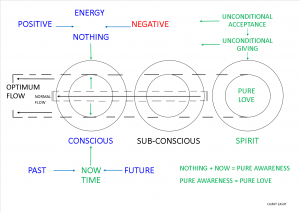
The above chart shows how spiritual principles open up the channel between the subconscious mind and the conscious mind to allow for the optimum flow of information. It achieves this outcome when the 7 rules are aligned with the spiritual principles and the team goal.
Optimum team flow moves each team member moves to an inside- outside model of meeting needs not an hierarchical model as shown earlier in the blog. The optimum attachment is as follows. The word love [of the game] incorporates all the spiritual principles.
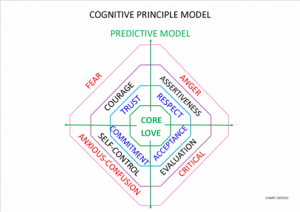
Trust and Respect attached to the team members
Acceptance and commitment attached to the team goals.


