


HOW TO ACHIEVE YOUR GOAL
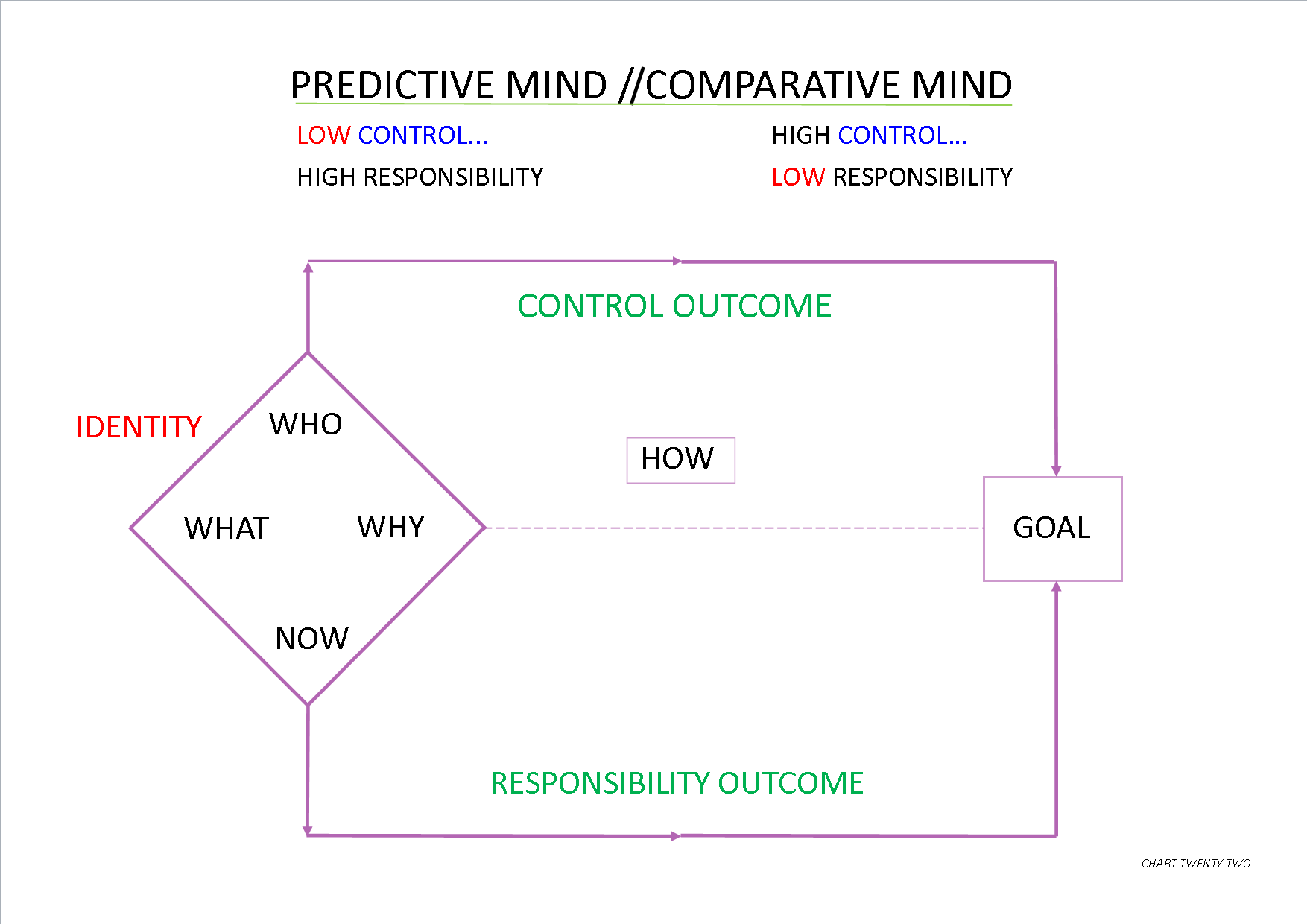
You can consciously choose which mind to use when you are facing a problem of how to achieve your goal. The two minds are the predictive mind or the comparative mind.
The two main factors that involve decision making is firstly your identity and secondly the degree of control you have over the outcome.
IDENTITY: Who, What, Why, Now.
In personal grow situations always put your self first [internally only], by asking yourself questions in the following order:
WHO am I, NOW?
WHAT do I want?
WHY do I want it?
When facing situations most people want to know how to fix the problem, without knowing who they are, what they want or why they want it. You must know “Who am I?” based on your principles, before you ask “What do I Want?” otherwise an internal conflict is created if the two aren’t aligned.
With dysfunction, when the question of “Who am I” is asked the person may not know or give an answer that feels uncomfortable. This is because the explicit “Who am I” and the implicit “Who am I” are different. The implicit answer is within the subconscious mind and is not available as a thought, but only as a feeling to the conscious mind. The implicit “Who am I” can be adversely affected by unresolved issues from the past.
Some people become overwhelmed when they come to counselling because they have too many “how do I fix this” problems. Therefore, you always ask the question “Who am I, Now?” because you can only solve one problem at a time and you are only ever in the now, not the past or the future. That is, am I solving this problem as a father or an employee or a friend, etc?
When you ask “What do I want?” you must also ask “Why do I want it?” because it too may be affected by an unresolved issue from the past which is causing an inner conflict. For example, a client may say that “I want my mother to accept my new partner”. But when asked “why”, the response could be that “she never accepts any of my decisions” After discussing this issue with the client she may want to continue to try to get her mother’s acceptance or not try. However, if she does try then she needs to use her predictive mind and not her comparative mind, otherwise too many negative comparisons from the past will arise.
CONTROL: How
Once you have established what you want and why you want it, you then have your goal, however, you may or may not have the “how” to achieve the goal, because a goal needs a pathway. If the pathway to the goal does not exist or is blocked the goal will not be achieved.
When to use the comparative mind? How to achieve your goal.
The comparative mind works well when there is a clear goal and a pathway to the goal. The more experience, knowledge, skill and passion a person has then the more effective the comparative mind will be.
However, if the goal or pathway is not clear, then the comparative mind will provide too many negative feedback signals and the person can gets anxiety and loose control. Likewise if the person lacks knowledge, skill or experience then they can feel overwhelmed as they travel along the pathway towards the goal.
The comparative mind works best in positive situations, therefore use the two groups of positive principles, namely relationship principles and influencing principles. Relationship principles include, trust, respect acceptance and commitment. Influencing principles include courage, assertiveness, self-control, patience and persistence.
Rule is: When negative feedback starts to activate rumination, then stop using the comparative mind and switch to the predictive mind.
When to use the predictive mind? How to achieve your goal.
When you do not have a clear goal or your goal gets blocked then switch to the predictive mind. The predictive mind works with two groups of principles, namely negative principles and spiritual principles. The main spiritual principle is hope.
The predictive mind is hierarchical and can predict from the bottom up, using knowledge, skill and information which is already known, and it can work from the top down to predict what is missing to achieve the goal, now called hope.
With spiritual hope the outcome is known before the journey along the pathway commences. For the outcome to be known the person with hope must have complete control over the process, even if they don’t know what the process will be. For example, if you want to build a better relationship with your partner, then the hope is that you will try everything within your power to build that relationship, but you will always stick to your relationship values along the way. The hope is not to end up with a better relationship, because you have limited control over your partners behavior, the hope is for you to try everything you can which is within your complete control.
Once you have this type of hope the bottom up predictive mind will know from past experience what action will achieve good results and predict further ways to build on those. While the top down predictive mind will know what the end result will look like and predict the sort of experience, knowledge, or skills you require. You will find that subconsciously you are “lead” to find supporting situations which will feel co-incidental, but are part of the predictive mind which expects to find the answer.
The knowledge that comes from the bottom and top down predictive mind provides the understanding as you travel along the pathway, which generates more predictions.
Negative principles will still occur as you travel along the pathway, but you understand their purpose and use spiritual principles to overcome them.
The purpose of negative principles are to protect your boundaries as you travel along the pathway.
Fear never comes inside the boundary, its job is to warn you that your boundary is under attack. Fear is the partner of trust. eg. Trust the lion without fear and you are dead.
Anger is to defend the boundary from attack. Anger is the partner of respect. Low respect for self and others will result in high levels of anger, which is rage or abuse.
Critical, anxiousness, guilt and confusion are used to fix the boundary when it is broken, these are good feelings because keep you safe by restoring your boundaries. eg. If you never felt guilty, then you wouldn't try to fix the boundary and you become vulnerable to attack.
The purpose of the spiritual principles is to stop you activating comparative thinking.
Forgiveness is being able to forgive either yourself or the other person. Forgiveness is the ability to split the person from their behavior and forgive the person, while letting God, karma or whatever else you believe in, judge their behavior. Judging is caused by comparative thinking.
Peace is being able to sit with negative principles of fear, anger, anxiousness, guilt and accept those by not ruminating over those. Rumination is the weakness of comparative thinking.
Suffering follows peace, when you sit with your negative principles and then grow influencing principles such as courage, assertiveness, patience, persistence and self-control, rather than blame yourself, somebody else or life’s circumstances. Suffering and blaming is negative comparative thinking.


