


WALKING ON EGG SHELLS-A PATHWAY TO LOSS OF SELF.
This article is based on an adaption of Malcolm Gladwell's "The Tipping Point"-How little things can make a big difference. [2015 edition]
Galdwell writes about how epidemics occur and states that three principles are present, namely:
- The Law of the Few. That in epidemics, a certain type of person has a big influence in the process.
- Stickiness. that in order to be capable of sparking epidemics, ideas have to be memorable and move us to action.
- Power of Context. Epidemics are sensitive to the conditions and circumstances or times and places in which they occur.
Quote about the epidemic of domestic violence in Australia.
www.abc.net.au/radionational/programs/...epidemic-of-domestic-violence/6273516
"Mar 2, 2015 - Domestic violence has reached epidemic proportions in Australia and is now the leading preventable cause of injury and death in women under 45."
The cognitive principle matrix theory states that domestic violence between a couple is generated based on three principles which are similar to the principles used by Caldwell that he says can result in an epidemic:
- Dysfunctional person, the cause of the problem [Law of the few]
- Dysfunctional phase [Stickiness]
- The Violence-walking on egg shells [Law of context, any condition, any circumstance, anyplace or anytime]
Dysfunctional person versus a normal person:
Normal Person in a bad habit: The process is shown below where the normal person will experiencing one or more of the following four things:
- The head brain loses direction and there have temporarily lost their way.
- The heart brain have got out of balance and taken things personally.
- The gut brain has lost control or lacks the courage to act
The spirit has lost motivation to support the head, heart and gut brains.
The cause of the problem is ruminating [going over and over in the head brain] based on negative comparative thinking.

Dysfunctional Person in a very bad habit
The dysfunctional person in domestic violence has more than a 50% chance of having the following traits and behaviors:
- When under stress tends to be overly controlling, rather than normal or overly responsible or overly avoidant.
- Is likely to have unresolved issues from the past related to weakened relationship principles, in the areas of trust or respect or both.
- Of the 15 types of anger is more likely to have moral anger based on fixed or stubborn views about life. "I'm right, you're wrong". When challenged on his/her life views will resort to revengeful anger, where the challenging person has to be punished more that he /she was hurt.
- Develops a very bad habit, by not only ruminating over what the challenging person did, but predicting that their behavior will not change. The dysfunctional person gets into a negative comparative-predictive-loop as shown below:

Dysfunctional Phase:
In the cognitive principle matrix there are three phases:

The Violence-walking on egg shells [Intolerance factor]
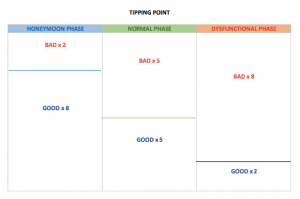
As the relationship between a couple deteriorates there is a rapid change in response to positive or negative comments.
- In the honeymoon phase positive comments or actions are given a high rating, say 8 out of 10, whereas negative comments are given a low rating, say 2 out of ten. The reverse of this happens during the dysfunctional phase. The transition through the phases can happen slowly or quickly. It often happens in certain circumstances, such as moving in together, getting married, having a child, the victim stops working, whenever the dysfunctional person feels they have control.
- The intolerance factor generates the tipping factor into domestic violence, which can occur and any place or place or in any condition or circumstance
- What most people don't know is that the subconscious mind can't tell the difference between an actual event and ruminating [mind wandering]. Therefore the intolerance point can occur in the mind of the dysfunctional person, even though there is no external event. This creates the "walking on eggshells" by the victim, trying to read the mind of the abuser.
- Mind wandering is a default mechanism as shown below:

In a very bad habit, the negative-comparative-predictive-loop in mind wandering phase, increases the dysfunctional person's intolerance factor without the the dysfunctional person or the victim knowing that it is happening.
The very bad violent habit is sitting in the DMN procedural negative pathway.
The dysfunctional person is stuck at level 1 in the cognitive principle matrix:

The dysfunctional person is acting out with violence. They are exercising false control, inflicting pain, taking things personal and making them personal. They have negative concerns experiencing paranoid fear about what the victim is doing too them, feeling rage, and rejecting the person. All these negative emotions are then transferred to the victim.
Finally, all support of the spirit in both the dysfunctional person and the victim is lost, life seems hopeless and the spirit feels dead. Both parties end up on the negative side of life and are completely lost.


