Using cognitive wisdom versus spiritual wisdom to deal with non physical fear.

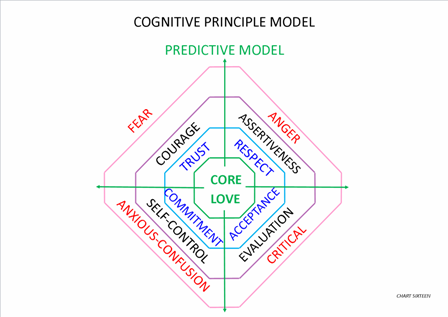
In the Cognitive Principle Matrix cognitive wisdom is based on applying influencing principles, relationship principles and some spiritual principles which enables a person to reach a level 4 on the above chart, whereas spiritual wisdom is based on experiencing spiritual principles while operating at level 5 on the chart.
Cognitive wisdom.
Professor Richard Harrison of the University of Edinburgh produced the following chart to explain how logic is applied to knowledge, experience and skill to arrive at wisdom, but ensuring that wisdom is based on sound ethical principles. Professor Harrison, stated that wisdom is often based on superior knowledge and does not take into account values or principles.

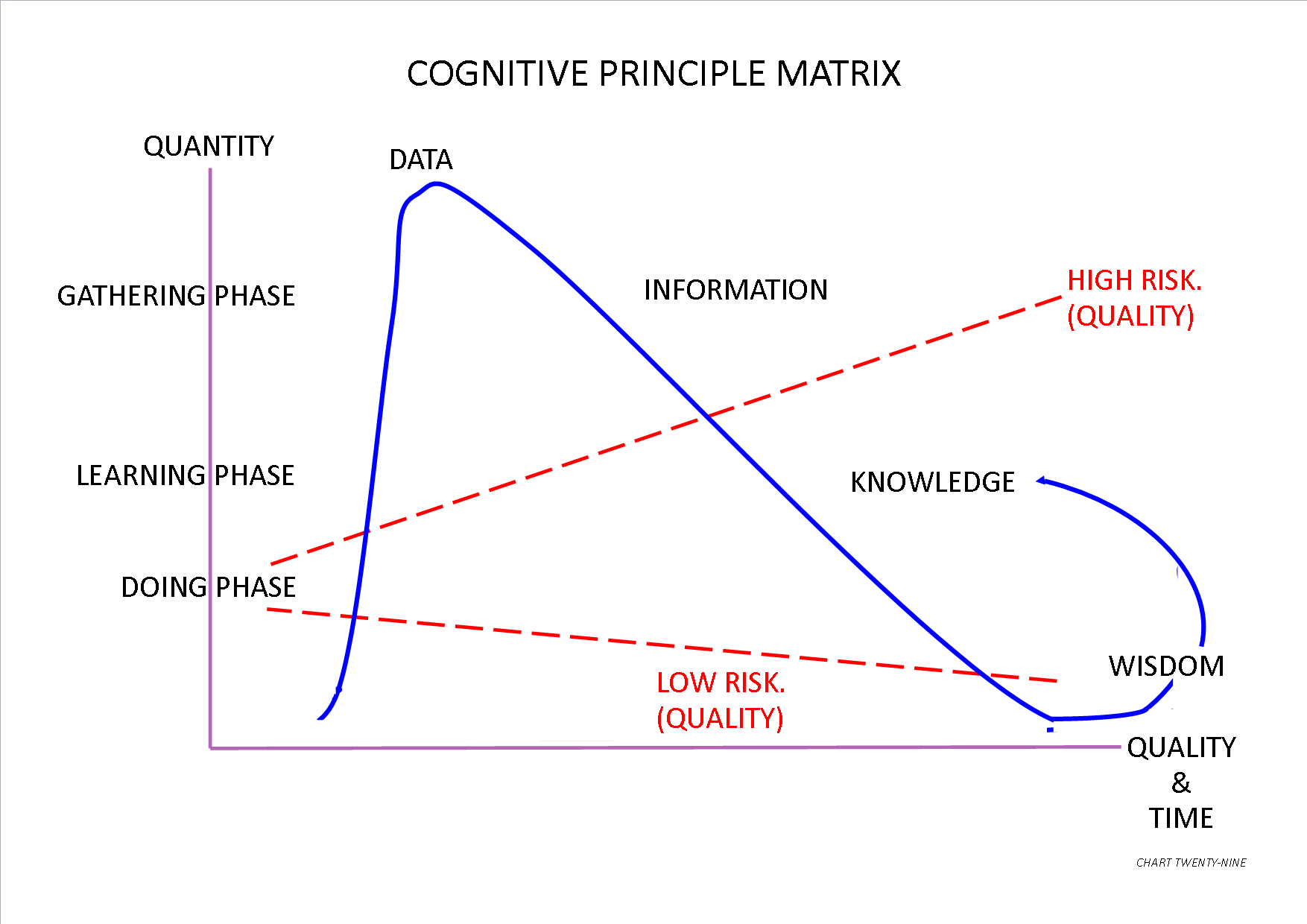
The above chart shows what happens if you commence the "doing phase" too early, that is, before you have sufficient knowledge or wisdom. [red line-high risk] The blue line is the correct path where you gather all the data and information, create knowledge, apply wisdom based on principles or values and then commence the doing phase. [blue line end point.]
Spiritual wisdom
5 levels of awareness.
Level 1 -Aware that fear is controlling your behavior, but you can do nothing to prevent it, because it has entered inside your boundary, and linked onto other negative emotions such are anxiousness, anger, sadness and confusion. That is, you are being controlled by your reptilian brain or limbic system. You need spiritual forgiveness to move to level 2.
Level 2-Aware that fear is controlling your behavior and that your influencing principles, such as courage, patience, persistence, assertiveness and self-control are trying to overcome the fear by pushing it back outside your boundary. You are trying to control your fear, but are struggling to do it. That is, your neocortex has become involved and you are aware of what is happening, but can’t do anything to stop it. You need to find spiritual peace to move to level 3.
The above chart shows level 1 & 2 response where fear is not controlled.
Level 3-Aware that fear belongs outside your boundary and you have successfully used your influencing principles to keep it there, but you feel under threat due to constantly ruminating over negative events. Each time you ruminate, fear is generated. That is, your neocortex is using logic and positive thinking to control your fear, but you slip into negative thinking and return to level 2. You need to find spiritual suffering and grow influencing principles of courage, patience, assertiveness, etc. If you suffer and blame others, yourself or circumstances then you will return to level 1 or 2.
Level 4-Aware of your spiritual principles such as humility, suffering, peace, and unconditional acceptance can support your influencing principles to keep fear outside your boundary. You have stopped ruminating, but are not at peace yet. That is, your neocortex is using logic and positive thinking to control your fear. You are aware that your spiritual principles are available to you, but you cannot yet use them to provide peace. You feel under constant stress on the inside, even though you have control on the outside. You need to use unconditional giving and rise above your own needs and move to level 5.
Level 5-Aware and can use your spiritual principles of unconditional acceptance to overcome fear and use fear for its true purpose. You are now at peace with fear. That is, your neocortex has accepted that this is an emotional threat, not a physical threat and that you can give up control to your spiritual principles and unconditionally accept the situation. You now understand that this is not fear, but awareness.
5 levels of communication
Level 1 Communication based on arguments about negative comparative thinking and trying for a win/loose outcome. Sometimes this can deteriorate into abuse, where things are taken personally and made personal. Fear is the basis of communication. Forgive the other person and deal with their behavior at level 2.
Level 2 Communication is based on discussion with both parties trying to get the other party to agree with them. Sometimes this can deteriorate into an argument. Fear is about being in control and having the upper hand. Find peace and remain calm, focusing on the discussion and not on winning. Suffer and grow assertiveness and but with rules, boundaries and consequences in place to protect yourself.
Level 3. Communication based on respectfully listening to each others point of view and trying to find the best outcome. Sometimes this can deteriorate into discussion. Fear is starting to disappear and will only reappear if trust, respect or acceptance breaks down. You are in control and starting to act assertively.
Level 4 Communication based on a dialog approach, but as it progresses then higher levels of empathy are reached. An agreed outcome is based on mutual benefit. There are minimal levels of fear present and control is not important. You unconditional accept the other person, but you are still conscious of your rules, boundaries and consequences.
Level 5. Communication based on bonding with both parties give up their needs in support of the other party after using dialog and empathy to arrive at an outcome. You have unconditional acceptance and you give unconditionally.
Spiritual wisdom is found at the level 5 intersection between Awareness and Connectedness.
It this level you are aware that you have transcended your fear through unconditional acceptance and risen above your greed with unconditional giving. You have therefore transcended the drivers human nature, namely fear and greed and attained spiritual wisdom.
Understanding our comparative mind
Our human nature is based on greed to achieve more goals, it is external and uses our comparative mind which provides a feedback system to follow a pathway and achieve our goal.
We also have an internal drive for love. In the Cognitive Principle Matrix the key elements of love are trust, respect, acceptance and commitment, these are called relationship principles. Love is achieved through secure attachment. Insecure attachment arises through lack of trust, respect, acceptance and commitment and will cause unresolved issues. The subconscious mind will continue to work on resolving the unresolved issues by recreating a similar set of circumstances to those which caused the unresolved issue.
If we have a weakened principle of trust, respect, acceptance, commitment etc, and we are tested on those, we can often develop negative emotions of fear, anger, guilt or anxiousness and can’t accept that feeling without going outside ourselves to either avoid or fix the weakened principle. we tend to ruminate and overuse our comparative mind.
Both cognitive and spiritual wisdom require secure attachment because wisdom is to based trusting, respecting and accepting yourself.
Understanding our predictive mind
In the cognitive principle matrix the predictive mind works with two groups of principles, namely negative principles and spiritual principles. The main spiritual principle is hope.
The predictive mind is hierarchical and can predict from the bottom up, using knowledge, skill and information which is already known, and it can work from the top down to predict what is missing to achieve the goal, now called hope.
With spiritual hope the outcome is known before the journey along the pathway commences. For the outcome to be known the person with hope must have complete control over the process, even if they don’t know what the process will be.
For example, if you want to build a better relationship with your partner, then the hope is that you will try everything within your power to build that relationship, but you will always stick to your relationship principles along the way. The hope is not to end up with a better relationship, because you have limited control over your partners behavior, the hope is for you to try everything you can which is within your complete control.
Once you have this type of hope the bottom up predictive mind will know from past experience what action will achieve good results and predict further ways to build on those. While the top down predictive mind will know what the end result will look like and predict the sort of experience, knowledge, or skills you require. You will find that subconsciously you are “lead, by intuition” to find supporting situations which will feel co-incidental, but are part of the predictive mind which expects to find the answer.
The knowledge that comes from the bottom and top down predictive mind provides the understanding as you travel along the pathway, which generates more predictions.
Negative principles will still occur as you travel along the pathway, but you understand their purpose and use spiritual principles to overcome them.
The purpose of negative principles are to protect your boundaries as you travel along the pathway.
Fear never comes inside the boundary, its job is to warn you that your boundary is under attack. Fear is the partner of trust. eg. Trust the lion without fear and you are dead.
Anger is to defend the boundary from attack. Anger is the partner of respect. Low respect for self and others will result in high levels of anger, which is rage or abuse.
Critical, anxiousness, guilt and confusion are used to fix the boundary when it is broken, these are good feelings because keep you safe by restoring your boundaries. eg. If you never felt guilty, then you wouldn't try to fix the boundary and you become vulnerable to attack.
The predictive mind holds all your rules, boundaries and consequences, which allows your to give up your comparative mind. Hope replaces your goal so that you do not need to use your comparative mind and go outside yourself.
Spiritual wisdom only uses the predictive mind, where as cognitive wisdom uses both the predictive mind and the comparative mind, which causes spiritual flow to be interrupted.
Understanding intuition
In Cognitive Principle Matrix intuition is a form of knowing. It comes about when an outside trigger or conscious thought focuses on a topic and doesn’t trigger a logical thought or a habit, but goes to intuition to find the answer.
A logical thought is controlled by the conscious mind. A habit is a thought controlled by the sub-conscious mind and is either negative or positive. A habit is rigid and difficult to change because the subconscious mind stores things in emotional order and the strongest habits are the ones with the higher emotions, which are mostly negative.
A person with limiting or fixed beliefs which have been developed out of negative emotions will most likely be stuck in the same habit or thinking pattern. They will not have access to free information available through intuition.
If the information necessary for understanding is held in implicit memory, then it is not available to the conscious mind. Thinking about it consciously will only trigger the bad habit in the subconscious mind and prevent the subconscious from revealing the knowledge which causes the emotional response.
Both cognitive wisdom and spiritual wisdom require the ability to have explicit knowledge, use intuition and not be stuck in habits and fixed beliefs.
Inside first, then Outside.
We have an internal drive to rise above our human nature by controlling fear and greed. It is not a moral decision of what is fear or greed, but how to control that in order to get what we want.
By controlling fear through unconditional acceptance (peace) and controlling greed though unconditional giving (love), then joy is achieved.
LOVE-PEACE-JOY then becomes an inside process not an external goal to be achieved through materialism, relationships, knowledge or religion [focusing on external rules, rituals or your own good works, rather than your belief]
By using spiritual principles of forgiveness, peace, suffering, unconditional acceptance and unconditional giving, the subconscious mind moves from the negative file generated from rumination and goes to your intuition. Intuition and hope go together subconsciously to achieve the desired outcome.
Hope and the spiritual principles move from inside to the outside, while awareness is on the outside monitoring information and knowledge coming in through the various layers of boundaries built around negative principles, influencing principles and relationship principles. Spiritual principles are sent from the inside to the outside to support the various boundaries.
Spiritual wisdom is achieved when there is awareness, connectedness and the predictive mind is working from the inside out, not the comparative mind working from the outside in. Awareness replaces fear on the outside and there is peace, love and joy on the inside.
Love flows freely with spiritual wisdom.