


Erik Erikson's Stages of Development and Maslow's Hierarchy of Needs and the Cognitive Principle Matrix
Approx. age Spiritual Psychosocial Cognitive-Principle Erikson Principles Erikson Positive Negative
0-2 years Love/Hope Trust v Mistrust Relationship Neg. Concerns
2-4 years Acceptance Autonomy v Shame Influencing Neg.Principles
4-5 years Acceptance Initiative v Guilt Influencing Neg. Principles
5-12 years Acceptance Industry v inferiority Influencing Neg Principles
13-19 years Acceptance Identity v Role Confusion Relationship Neg. Concerns
20-39 years Love/Giving Intimacy v Isolation Relationship Neg Concerns
40-64 years Hope Generativity v Stagnation Influencing Neg. Principles
65-death Acceptance Ego v Despair Influencing Neg Principles
The Cognitive Principle Matrix chart below shows the connection between Maslow's needs and the Principles.

In Cognitive Principle Matrix (CPM) comprises groups of principles. The principle groupings relate to our human nature driven by fear and greed. The first goal in CPM is to control fear by using spiritual principles to control negative principles and negative concerns. The second goal is to control greed by using spiritual principles to develop influencing principles and relationship principles, thereby transcending our human nature and finding pure love. Spiritual principles are used to move a person from the lowest level to the highest level to attain wisdom of love, peace and joy.When we attain this level we realise that love, peace and joy were already inside us and not an external goal to achieve.
The principle groups are:
- Negative Concerns: These are negative and taken personally
Apathy, hopelessness, rejection, shame. depression2. Negative Principles: These are negative, but behavioral
Fear-Anger-Critical-Anxiety3. Influencing Principles: These are positive and behavioral
Courage-assertiveness-evaluation-self control4. Relationship Principles: These are positive and personal
Trust-Respect-Acceptance-Commitment. - 5. Spiritual principles: These are used to neutralize negative or promote positive groups of principles. For example:
- Forgiveness to overcome negative concerns, which are taken personally. Split the person from their behavior, and forgive the person.
- Hope when your pathway out of the problem is blocked or you don’t have a pathway. Hope is based on trusting your intuition.
- Peace to overcome negative principles. Sit with fear, anger, anxiety and accept it with no responsibility to fix it. Peace kills both rumination and worry.
- Suffering to grow influencing principles. Eg. Suffer and grow assertiveness, rather than go into rage and abuse the person. Suffering is based on acceptance, if you suffer with influence. However, if you suffer with concern, you will blame the other person or yourself and go backwards to negative concerns.
- Unconditional accepting everything that is within your rules and boundaries related to trust, respect, acceptance and commitment. Accept with courage, assertiveness, evaluation and self-control.
- Unconditional giving everything within your rules and boundaries related trust, respect, acceptance and commitment.
- Love is combining the relationship principles with the spiritual principles.
Connection between the three theories:
Eriksons stages
0-2 years Love Trust v Mistrust Relationship Neg. Concerns
20-39 years Love Intimacy v Isolation Relationship Neg Concerns
Eriksons definition of stages 1 & 6:
Stage 1 -Trust v Mistrust.
Erikson's first psychosocial crisis occurs during the first year or so of life. The crisis is one of trust vs. mistrust.
During this stage the infant is uncertain about the world in which they live. To resolve these feelings of uncertainty the infant looks towards their primary caregiver for stability and consistency of care.
If the care the infant receives is consistent, predictable and reliable, they will develop a sense of trust which will carry with them to other relationships, and they will be able to feel secure even when threatened.
Success in this stage will lead to the virtue of hope. By developing a sense of trust, the infant can have hope that as new crises arise, there is a real possibility that other people will be there are a source of support. Failing to acquire the virtue of hope will lead to the development of fear.
Stage 6. Intimacy vs. Isolation
In Young adulthood we begin to share ourselves more intimately with others. We explore relationships leading toward longer term commitments with someone other than a family member.
Successful completion of this stage can lead to comfortable relationships and a sense of commitment, safety, and care within a relationship. Avoiding intimacy, fearing commitment and relationships can lead to isolation, loneliness, and sometimes depression. Success in this stage will lead to the virtue of love.
The Cognitive Principle Matrix changes Erikson's virtue of hope to love, which aligns with intimacy at stage 6. Failure to develop attachment at infancy will result in fear and a failure to be truly intimate in later life. Love is a spiritual principle supporting relationships. A failure to find love at stage 6 may result in negative concerns, where things are taken personally. The negative concerns are paranoid fear, rage, rejection, shame, apathy and panic.
Unresolved issues in love:
In cognitive principle matrix “Attachment” relates to any influencing person connected to the child using the relationship principles of trust, respect, acceptance, commitment and empathy. However, these are never perfect and create dysfunctional behavior on a spectrum between minor and major. This normally causes detachment issues as the child moves through adolescence to adulthood. In adulthood the child with dysfunctional relationship principles will re-attach to a partner who has the same dysfunctional principle, but the opposite way of dealing with it. Examples are:
• Trust: One partner cannot trust the other partner, while the first partner cannot trust themselves.
• Respect: One partner is overly controlling and abusive, while the other partner is overly responsible and compliant.
• Acceptance: One partner is a perfectionist, whilst the other partner is carefree.
This is a natural evolutionary process to strengthen a couple. If the couple work together and accept each others opposites, then they will work through their dysfunctional issues. However, if the dysfunctional issues are not corrected with their partner, they can becorrected at a later stage.
Eriksons definition of stages 2 & 5:
2-4 years Acceptance Autonomy v Shame Influencing Neg.Principles
13-19 years Acceptance -Identity v Role Confusion- Relationship-Neg. Concerns
Stage 2. Autonomy vs. Shame and Doubt
The child is developing physically and becoming more mobile. Between the ages of 18 months and three, children begin to assert their independence. The child is discovering that he or she has many skills and abilities, such as putting on clothes and shoes, playing with toys, etc. Such skills illustrate the child's growing sense of independence and autonomy. Erikson states it is critical that parents allow their children to explore the limits of their abilities within an encouraging environment which is tolerant of failure.
The aim has to be “self control without a loss of self-esteem” (Gross, 1992). Success in this stage will lead to the virtue of will.
If children in this stage are encouraged and supported in their increased independence, they become more confident and secure in their own ability to survive in the world.
If children are criticized, overly controlled, or not given the opportunity to assert themselves, they begin to feel inadequate in their ability to survive, and may then become overly dependent upon others, lack self-esteem, and feel a sense of shame or doubt in their own abilities.
Stage 5. Identity vs. Role Confusion
During adolescence (age 13 to 19 yrs), the transition from childhood to adulthood is most important. Children are becoming more independent, and begin to look at the future in terms of career, relationships, families, housing, etc. The individual wants to belong to a society and fit in.
This is a major stage in development where the child has to learn the roles he will occupy as an adult. It is during this stage that the adolescent will re-examine his identity and try to find out exactly who he or she is. Erikson suggests that two identities are involved: the sexual and the occupational.
Erikson claims that the adolescent may feel uncomfortable about their body for a while until they can adapt and “grow into” the changes. Success in this stage will lead to the virtue of fidelity.
Fidelity involves being able to commit one's self to others on the basis of accepting others, even when there may be ideological differences.
Failure to establish a sense of identity within society ("I don’t know what I want to be when I grow up") can lead to role confusion. Role confusion involves the individual not being sure about themselves or their place in society.
The Cognitive Principle Matrix changes Erikson's Stage 2 virtue of will to acceptance, which matches acceptance of their identity and role in stage 5.
Stage 2 acceptance relates to behavior which affects our influencing principles.
However, acceptance in stage 5, refers our relationship principles affecting our identity and role in society.
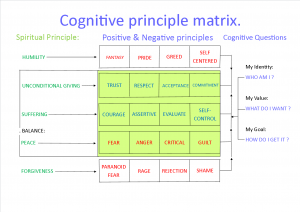
In stage 2, if our behavior is not accepted and we are criticized too heavily we develop guilt, anxiety and confusion. However, at stage 5 if our identity and role in life is not accepted, then we take it personally and feel rejected and shameful.
Eriksons definition of stages 3 & 7:
4-5 years Hope Initiative v Guilt Influencing Neg. Principles
40-64 years Hope Generativity Stagnation Influencing Neg. Principles
Stage 3. Initiative vs. Guilt
Around age three and continuing to age five, children assert themselves more frequently. These are particularly lively, rapid-developing years in a child’s life. According to Bee (1992) it is a “time of vigor of action and of behaviors that the parents may see as aggressive".
During this period the primary feature involves the child regularly interacting with other children at school. Children begin to plan activities, make up games, and initiate activities with others. If given this opportunity, children develop a sense of initiative, and feel secure in their ability to lead others and make decisions.
Conversely, if this tendency is squelched, either through criticism or control, children develop a sense of guilt. They may feel like a nuisance to others and will therefore remain followers, lacking in self-initiative.
Too much guilt can make the child slow to interact with others and may inhibit their creativity. Some guilt is, of course, necessary, otherwise the child would not know how to exercise self control or have a conscience.
A healthy balance between initiative and guilt is important. Success in this stage will lead to the virtue of purpose.
Stage 7. Generativity vs. Stagnation
During middle adulthood (ages 40 to 65 yrs), we establish our careers, settle down within a relationship, begin our own families and develop a sense of being a part of the bigger picture.
We give back to society through raising our children, being productive at work, and becoming involved in community activities and organizations.
By failing to achieve these objectives, we become stagnant and feel unproductive. Success in this stage will lead to the virtue of care.
The Cognitive Principle Matrix changes Erikson's virtue of Purpose in Stage 3 and Care in stage 7 to Hope.
Stages 3 and 7 relate to behavior and refer to motivation. Excess guilt in stage 3 and stagnation at stage 7 will reduce hope and therefore motivation to succeed, whereas the development of initiative at stage 3 and the ability to have hope of the future and see the big picture will generate motivation in stage 7.
Eriksons definition of stages 4 & 8:
5-12 years Acceptance Industry v inferiority Influencing Neg Principles
65-death Acceptance Ego v Despair Influencing Neg Principles
Stage 4. Industry (competence) vs. Inferiority
Children are at the stage (aged 5 to 12 yrs) where they will be learning to read and write, to do sums, to do things on their own. It is at this stage that the child’s peer group will gain greater significance and will become a major source of the child’s self esteem. The child now feels the need to win approval by demonstrating specific competencies that are valued by society, and begin to develop a sense of pride in their accomplishments.
If children are encouraged and reinforced for their initiative, they begin to feel industrious and feel confident in their ability to achieve goals. If this initiative is not encouraged, if it is restricted by parents or teacher, then the child begins to feel inferior, doubting his own abilities and therefore may not reach his or her potential.
If the child cannot develop the specific skill they feel society is demanding (e.g. being athletic) then they may develop a sense of inferiority. Some failure may be necessary so that the child can develop some modesty. Yet again, a balance between competence and modesty is necessary. Success in this stage will lead to the virtue of competence.
Stage 8 Ego Integrity vs. Despair.
As we grow older (65+ yrs) and become senior citizens, we tend to slow down our productivity, and explore life as a retired person. It is during this time that we contemplate our accomplishments and are able to develop integrity if we see ourselves as leading a successful life.
Erik Erikson believed if we see our lives as unproductive, feel guilt about our past, or feel that we did not accomplish our life goals, we become dissatisfied with life and develop despair, often leading to depression and hopelessness. Success in this stage will lead to the virtue of wisdom. Wisdom enables a person to look back on their life with a sense of closure and completeness, and also accept death without fear.
The Cognitive Principle Matrix changes Erikson's virtue of competence in Stage 4 to acceptance and wisdom in stage 8 to unconditional acceptance and unconditional giving based on wisdom.
If we achieve "Ego integrity" at stage 8 then we have successfully completed the cycle and have learned how to transcend our human nature using unconditional giving to transcend our greed and unconditional acceptance to transcend our fear. As human beings we are in this constant struggle to overcome our fear and greed and find love, peace and joy.


